martin annotated

200

categories


[..]
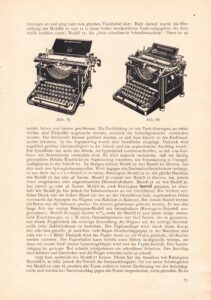
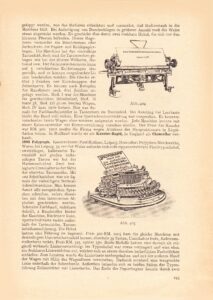
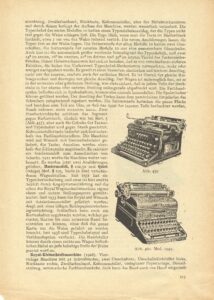
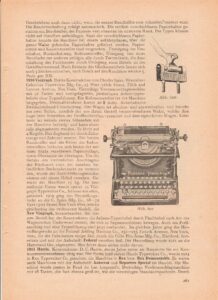
Mod. 2 (1905) has not undergone any significant changes, but numerous parts that were previously made of cast iron are now stamped from steel. A number of improvements were made to Mod. 3 (1913). This model has an automatic line feed mechanism, the two margin stops can now be moved by pressing a spring-loaded lever, there are carriage releases on the right and left, and the form has also become more pleasing. Mod. 4 (1924) brought the backspace key, and furthermore, carriages for 42 cm wide paper could also be supplied for this model. Olympia-Plurotyp (1933) is the last model developed from the Mignon, in which three different escapement dogs could be set. With this device, it is possible to adjust the width of the text lines to one another and to achieve advantageous effects in the case of advertising material.
350000 Mignons were sold over the years, evidence that such a machine could easily compete with the more expensive keyboard typewriters at the time.
[..]
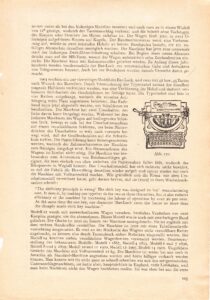
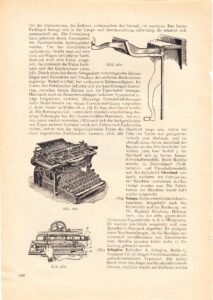
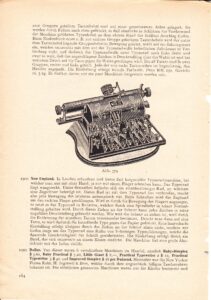
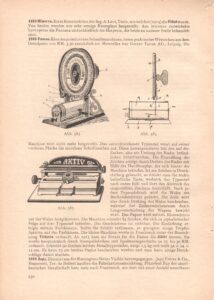
1904  Abeille.  Despite repeated requests for information on the spot, no essential details could be found about this system, which has long since disappeared. Valladon-Bordeaux wrote about this in his Annuaire de la Sténodactylographie et du Bureau moderne etc. (1911-1912) as follows: Abeille, Usine à Paris, rue Mozart 52 bis XVIme, clavier réduit amovible, 30 touches, 90 caractères, ruban bicolore. Chariot à train baladeur. Ecriture visible.
1904  Alexander.  [..]

annotations(6)

1

Mod. 2

show in text

This is where Martin goes wrong. The operation of the Mignon described above concerns the Mignon 2, and this is also explicitly stated in the two previous editions: “This is how model 2 shown in fig. 347 works”. Perhaps Martin applied that description to all Mignons, including the model 1. That is why he wrote that the model 2 had not changed. He most likely never saw Model 1.
That does not alter the fact that one small sentence about the model 2 is very little. Now, among other things, a reference to the red Mignons, and the latest, transitional version to the model 3, is missing.

2

In the 1939 and 1941 editions of his own Fabriknummern-Verzeichnis it says ‘since 1931’. That gives a date for the start of sales, but also suggests production that is still running at that time. In the 1934 edition of his book, Martin gave 1933 as the date of publication. In Burghagen’s Liste the Plurotype is not included until the 1953 edition. Date: from 1932. However, the serial numbers of the few surviving Plurotyps, according to the same Burghagen list, give 1930 as the starting year and 1932 as the end date of sale.
Dingwerth wrote ‘got into production in 1933’. The Olympia-Chronik of 1968 came to the following conclusion, on the basis of the Olympia-Rundschau of February 1933: “1933. In order to utilize the remaining parts of the ‘Mignon’, the Mod.4 [was] further developed into the OLYMPIA Plurotype [..] and brought to the market”.

literature

1934 Ernst Martin, Die Schreibmaschine und ihre Entwicklungsgeschichte, Pappenheim 1934, p.391
1939 (ed.Johannes Meyer), Fabriknummern-Verzeichnis, 3rd edition, Pappenheim 1939, p.XIII
1968 Olympia-Chronik, Wilhelmshaven 1968.08.15, III. 1923-1938, p.58
2008 Leonhard Dingwerth, Die Geschichte der deutschen Schreibmaschinen-Fabriken, volume 1, Delbrück 2008, p.74

3

350000 Mignons were sold over the years

show in text

.. although some later company records speak of 500000 Mignons.

4

Abeille

show in text

‘Abeille‘ means bee. In French technical literature, not one reference to this Abeille can be discovered. In this aspect it is quite logical that Martin could not find even a trace of information. In his earlier editions he specifically asked for such information: “Weitere Einzelheiten nimmt der Verleger gerne entgegen”, further details were willingly accepted by the publisher. But if no information, other than from his source was known, where did the year 1904 came from ? The same source, which he called Valladon-Bordeaux, edited another earlier yearbook, in 1909, in which no Abeille was recorded.
If the machine ever existed, it would be the first of two Bee machines. In 1934, the German Carissima came onto the market and was exported as a Bee for a short time.

literature

1909 A. Navarre/G. Valladon, Annuaire de la Sténo-dactylographie, Bordeaux 1909
5

Valladon-Bordeaux

show in text

Valladon-Bordeaux doesn’t exist. Here, Martin may have used the notes he had from his stay in Paris. If he had turned up page 318 from his own 1920-issue, or idem his 1934-issue, he should have known that ‘Valladon-Bordeaux’ was Germain Vallodon, living at 15, Rue de Soisson in Bordeaux, France. This Germain Valladon edited a first Annuaire in 1909 together with Albert Navarre.
On page 558, Martin even listed Germaine(!) Valladon (but correctly written in the 1934 issue) under reference to his own bibliography. There however, in 1914, no entry was found.

literature

1909 A. Navarre/G. Valladon, Annuaire de la Sténo-dactylographie, Bordeaux 1909
6

Usine à Paris, rue Mozart 52

show in text

The original text in the Annuaire is: “Usine à Paris, rue Mozart, 52 bis (XVIe)”. Nowadays, this rue Mozart has been upgraded and is called Avenue Mozart, indeed in the XVI district, and beside a number 52, the number 52 bis still exists.
There is another Rue Mozart, situated in Paris Ivry-sur-Seine. In this short street there is also a no.52.

It cannot be excluded that a real ‘usine’, a real factory, was housed at Avenue Mozart 52 bis. But maybe it was only about assembling instead of manufacturing. In that case, the Abeille might have been an existing foreign machine with some expired patents behind it.

literature

1911 Annuaire de la Sténo-Dactylographie et du Bureau Moderne 1911-1912, Bordeaux 1911, p.34

Become a Member

interested in reading the complete texts and having full access to the website? subscribe now!
€ 12 per year

One-Year Membership

Become a member and be surprised. New content added frequently.
Surf through Typewriters Paradise for just € 12 per year!.Only € 1 per month!

Sign Up