contents
0.1 preface
0.1.1 contents
0.2 introduction
0.3 prologue
1
1.1 de marcy
1.6 kabouter
2 felio
[..]
contents
0.1 preface
0.1.1 contents
0.2 introduction
0.3 prologue
1
1.1 de marcy
1.6 kabouter
2 felio
[..]
If you want to include the Southern Netherlands as part of the Netherlands, then Jean-François de Marcy is the first Dutchman to have invented a writing machine. Note, it concerned a writing machine, not a typewriter.
De Marcy is an eighteenth-century native; the Southern Netherlands were then Austrian territory, and their inhabitants did not call themselves Dutch, but rather felt themselves to be inhabitants of the province or region in which they lived. In De Marcy’s case, that was the the province of Belgian Luxembourg. But otherwise, nothing stands in the way of De Marcy’s claims to be the first from the Netherlands to design such a machine. To what extent he was original in doing so, and whether such a device actually existed, remains an open question. For the time being, nothing is known about it.
 Very little information has been preserved about Abbé Jean François de Marcy. He was born as Jean Bosquet in Chassepierre—very far south in the Southern Netherlands—or perhaps Verdun, in which case he is a Frenchman. There is also uncertainty regarding his year of birth. 1707 is mentioned, as is 1710.
He was a scientist, and in that capacity we find him in Vienna as a mathematics teacher in the 1760s. He taught Archdukes Ferdinand and Maximilian. The last two sons of Franz Stephan von Lothringen and Maria Theresa of Austria, Emperor and Empress of the still-existing Holy Roman Empire, were teenagers at the time.
It was a side job. De Marcy came to Vienna as early as 1744, and from 1748 until 1772 he was director of the Physikalisch-mathematischen Kabinett in Vienna.
writing machine
Without any further information, relevant texts state that De Marcy had built a writing machine in 1767, a hitherto unknown machine in typewriter literature. However, a source for those texts is unknown to me. It cannot be ruled out that, if built, the machine was inspired by Friedrich von Knaus’s writing machines, which were made in 1758 and 1759 for the Physikalischen Kabinett led by De Marcy (Von Knaus models II and III). Von Knaus’s fourth writing machine, the so-called ‘allesschreibenden Wundermaschine’, was also included in the Physikalischen Kabinett in October 1760. In those days, Von Knaus was court mechanic for some time, and in that capacity under the care of De Marcy.
If not a writing machine à la Von Knaus, the eventual De Marcy machine could also have been a pantograph. Von Knaus had already constructed his own triple writing variant of it earlier, in 1764.
 In the list that was handed over to the University of Vienna when the Physikalischen Kabinett was dissolved in 1790, a pantograph is mentioned under number 105: Maschine unter einer Dreijfach zu schreiben, a machine to write under a triad. However, there is no reference to the maker.
In a long thought to be lost, but recently rediscovered inventory of the k. k. Physikalisch-mathematischen Kabinett from 1773. Three machines are listed, all by Von Knaus, including the pantograph.
Is De Marcy’s writing machine a fable then, or a scientific misinterpretation ? In any case, it is a fact that in the Low Countries, from the last quarter of the 18th century onwards, people were at least aware of the existence of writing machines.
[PS. The source of the claim has only been known to me for two days and will still need to be verified].
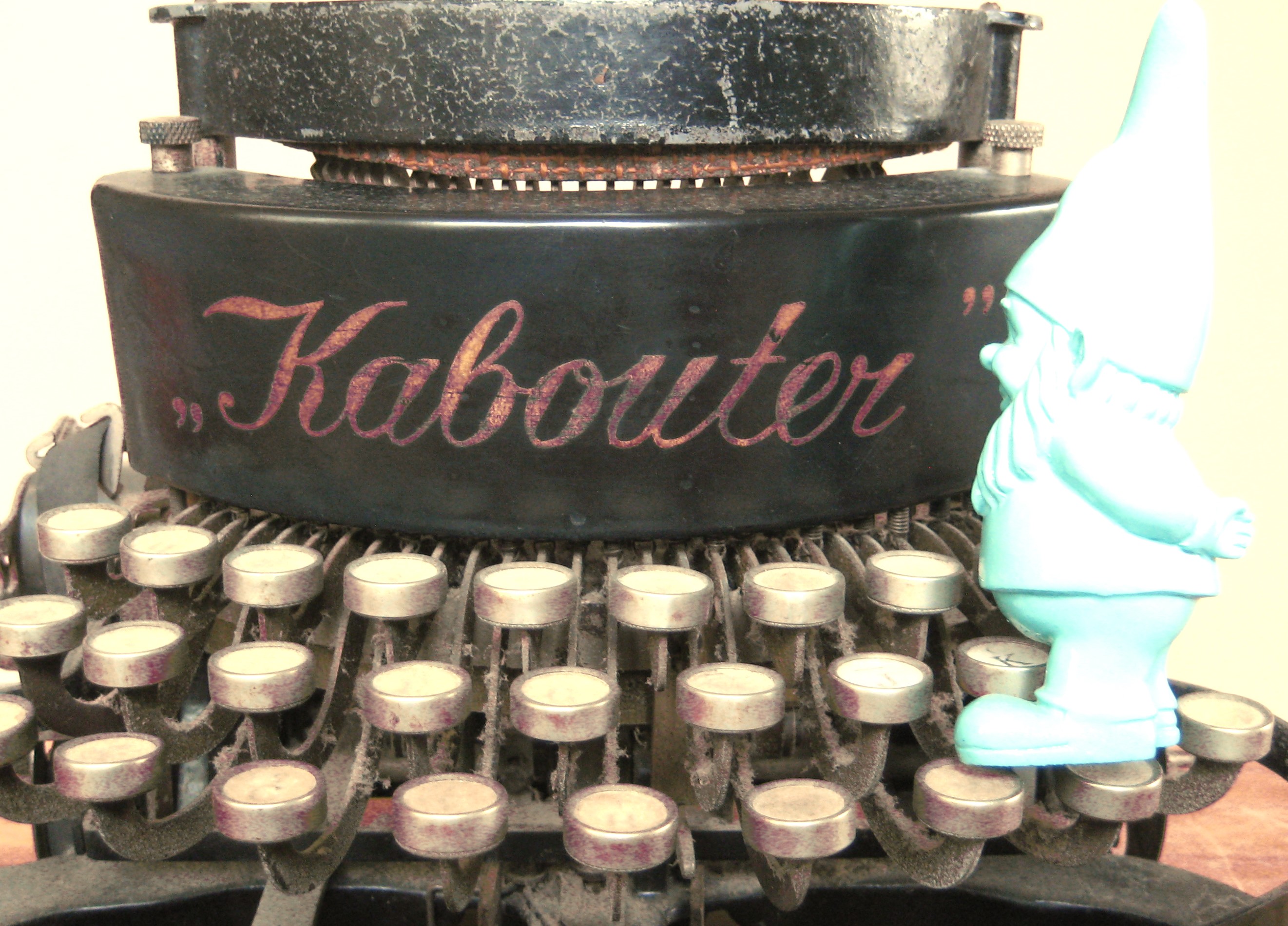
During the war years, in which, for that matter, the Netherlands was neutral, a German machine suddenly appeared under the very Dutch-sounding name Kabouter. It is a Faktotum Model 2. The Faktotum dates from late 1912 and the Model 2 from late 1913. A handful of those Kabouters are known.
Kabouter means Gnome. The name is prominently displayed on the front of the machine, but no reference can be found to the manufacturer, the seller, or the name Faktotum. The machines have a qwerty keyboard, and the function keys have Dutch inscriptions.
It is hard to fully understand why you would want to give the Faktotum the name Kabouter (Gnome). There was a Gnom, a miniature version of the already small Liliput, but the Faktotum is a solid mid-range machine. Possibly not for a Dutch intermediary, who was only familiar with Standard machines.
 The name Kabouter is applied by hand-painting, in the style of the Faktotum. Consequently, none of these inscriptions are the same. Moreover, two hands can be distinguished. On the later machines, we see, among other things, a different K and, on the right, the stroke under the word starting from the last letter, as also occurs on the Faktotum.
The earliest known Kabouter has a top cover that differs from the Faktotum.  As is also the case with Faktotums, that cover above the types is missing on some Kabouters. Fürtig believes that the much-vaunted visibility of the writing was rather disappointing: “The upper type cover obstructs the view of the writing, therefore some users removed it along with the support columns, and it is now missing from many copies”. However, a possible culprit is likely the material from which the type cover is made, a zinc alloy. It turns out it was not destined to last forever.
the seller
Who was responsible for the sale of the Kabouter remains a mystery for now. Nor can anything be found regarding the possible sale of Faktotums in the Netherlands.  There is only one reference: Carl Lehmann from Hornau in Germany, who sold the Faktotum 2 under the name Leframa. He advertised this directly in the Algemeen Handelsblad. ‘German Made !’ it stated, which was perhaps not a recommendation.
It is curious, to say the least. Production of Faktotums had been halted in 1916 due to the war, and you would think that there would be sufficient demand for typewriters in Germany.
The advertisement dates from September 1916. The earliest known serial number for Leframa is # 3431, and for Kabouter is # 3538. Since then, two small batches of a few dozen Kabouters each were delivered to the Dutch distributor. It possibly involved two deliveries of 50 machines each. This may also explain the previously noted difference in hand-painted inscription. The last batch also includes a Leframa.
It is tempting to assume that Lehmann was responsible for the sale of all those machines; however, that is by no means proven. Moreover, it remains strange that so few Faktotums, under their own name, were sold in Germany during the period after 1916.
advertisements
 After the end of the war, several Kabouters were offered for sale in private advertisements. One of them, from 1925, tells us that the purchase price had been fl. 200, and that it also came with a one-year warranty. Quite pricey when you consider that Fles & Co offered the Adler 15 for fl. 175 in mid-1916.
Another advertisementfrom 1918, promoted a Kabouter with a two-colour ribbon and a back space. That comes very close to the Realm of Fables.
In his own words, Johannes Meyer started what would become his life’s work in 1920. He presumably lived in St.Gallen, Switzerland, at the time. Initially, separate small booklets were sent out monthly. He took the shipping process into his own hands. To this end, he had built up an enormous address file, which he also exploited.
 Meyer had typewriter agents in mind as the target group for his initiative, as can be derived from an early order card from 1922. Apparently, Meyer was convinced that they would benefit from his information. Especially shortly after the First World War, with a shortage of typewriters, there was a demand for second-hand machines. Agents and repairmen provided for that need. Later, he also released the Fabriknummerverzeichnis, a serial number list, which he recommended as follows: “Your colleague X. is subscribed to the Schreibmaschine und ihre Entwicklungsgeschichte and consequently has the Fabriknummernverzeichnis, which immediately gives him the desired information. He does not pay fantasy prices for old machines. As a result, he can sell them cheaper. He does not have that many shelf warmers.”
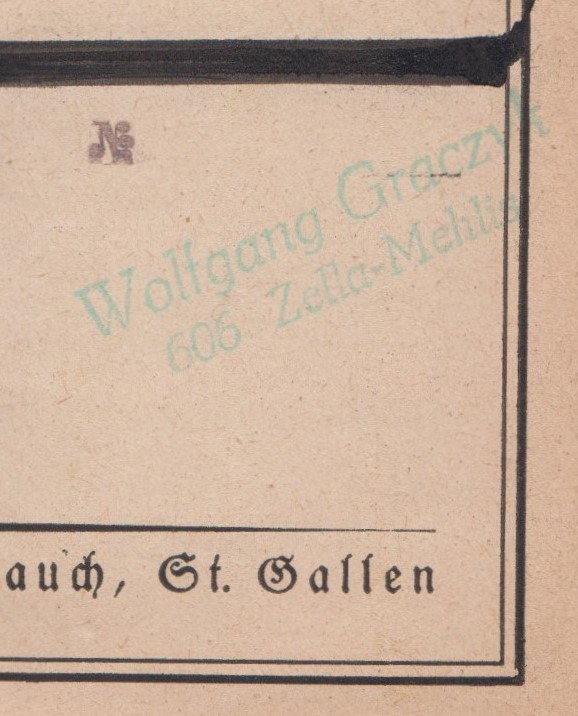 There is little information about the buyers of Meyer’s books. Occasionally, a stamp can be found in the earliest booklets themselves. Wolfgang Graczyk from Zella-Mehlis is one of the former owners, Franz Biener another, but nothing could be chronicled about their profession yet. There is a handwritten text in a 1923 edition, ‘Ernst Gall, 1925-1929, Pressburg’, which is in present-day Slovakia, but at that time, was called Bratislava.
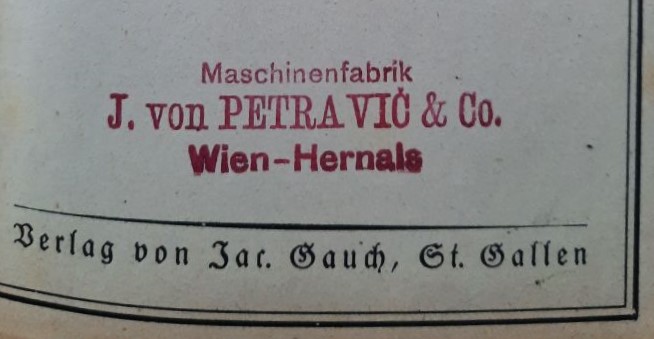 Early on, there was demand from abroad. A good example is the two volumes with a stamp of the Maschinenfabrik J. von Petravič & Co in Vienna (AT). Von Petravič & Co fabricated the Amata typewriter in 1923. It also mentions the name of its constructor, Adolf Reisser.
 Also from Vienna, and perhaps more sensationally, are the two earliest volumes in the former possession of Egon Ivellio-Vellin. The beginning of that company was in 1916. There is a photo from the early days with the founder amidst his machines. On top of the display case, in the midst of all kinds of small desk items, it seems that to the left and right of a calendar there are the two small volumes of Martin’s Die Schreibmaschine und ihre Entwicklungsgeschichte. If so, it is the only time we have seen the books in their natural habitat. At least those books still exist. They carry a sticker with the reference ‘zur Wiener Schreibmaschinen-Börse’, to the Vienna Typewriter Exchange.
What Meyer may not have foreseen, initially, is the interest from business schools. There was a copy in the library of the Staatliche Handelsschule in Gotha, founded in 1926. There was also a copy at the Verband der deutschen Wirtschaftskammer (in Austria).
There was a similar interest in the later editions. We noted Otto Heineke, as well as Ing. Richard Kißling, Büromaschinen, working in Hamburg, A. Voigt from Leipzig, and Robert Klopfer in Stuttgart. Abroad, it generally concerned people interested in German-speaking countries, such as Adolf Janovsky, Feinmechanikermeister (precision mechanics master) from St.Pölten (AU) and Hermann Wäry in Frauenfeld (CH).
 Also typical is the dedication in a 1949 edition: Mister Streithorst / at the end of his apprenticeship and beginning his assistant period at our company: Bremen, September 1951 / Erich: Martin Isenberg. For the same 1949 edition, a double ownership is even known: two dealers from Berlin. The Gebr. Weinitschke bought the book in 1950 and Walter Wagner was the next owner in 1970. Wagner was later active on the Berliner Seite, a typewriter research collective in the 1980s. Now that book is in TP’s Archives.
 Martin’s book could be found in many workshops, but also at state institutions such as the Dutch PTT and the GDR Patent Office. Technical museums were understandably interested, such as the Dutch Schrift- en schrijfmachinemuseum, of which here is an image. After the 1970s, Martin’s work mainly came to the attention of typewriter collectors.
[..under construction], however, here is the serial number list of the Faktotum due to research into the Kabouter, a name variant of the Faktotum 2.

Ask a typewriter collector what the French key order is, and he will answer azerty. In that keyboard, the Q and the A of the American universal keyboard were swapped and the W disappeared to the far left on the bottom key row. Its history, as always, is more nuanced.
France was not at the forefront of Western countries that embraced the typewriter around 1880. Certainly, until 1900, there was a rather reserved attitude towards the mechanisation of the office.
 However, remarkably enough, from about 1890 onwards we see a separate French keyboard arrangement, the awerty keyboard. It is a small intervention in the American universal keyboard, a simple letter exchange, although the reason for this is unknown. It can be found on single and double-keyboard machines. This specific letter order will last until about 1910.
In the meantime, things were happening. As early as 1890, a certain Alfred Valley proposed a radically modified keyboard, with vowels on the left and consonants on the right. In France, it did not draw a response, however, … we see it again later as the ‘clavier Belge’, the Belgian keyboard.  In 1907, the ‘clavier français’ was launched, the French keyboard, but it failed to gain popularity, with one exception: as the standard key order for the Typo.
The azerty keyboard has been in common use in France since 1910, and it remains so to this day, although nowadays new computer keyboards are being tried out, based on the good old Dvorak keyboard, such as Dvorak-Fr and Bepo.
The only developments that still related to typewriters took place in the 1970s. From 1978 onwards, a certain Mr. Paris from New Caledonia worked on his own keyboard, and invented the wheel. It was based on letter frequency and did not differ much from what Valley had devised eighty years earlier, except that the vowels are now reserved for the right hand.
 The ergonomic keyboard by Claude Marsan from Chaumont seemed more promising with double the typing speed. Marsan’s keyboard was also based on letter frequency, and he even got a patent for it. There were applications on a Japy typewriter, and IBM also seems to have been interested, but in the end, no more than twenty machines were made to try out the system.
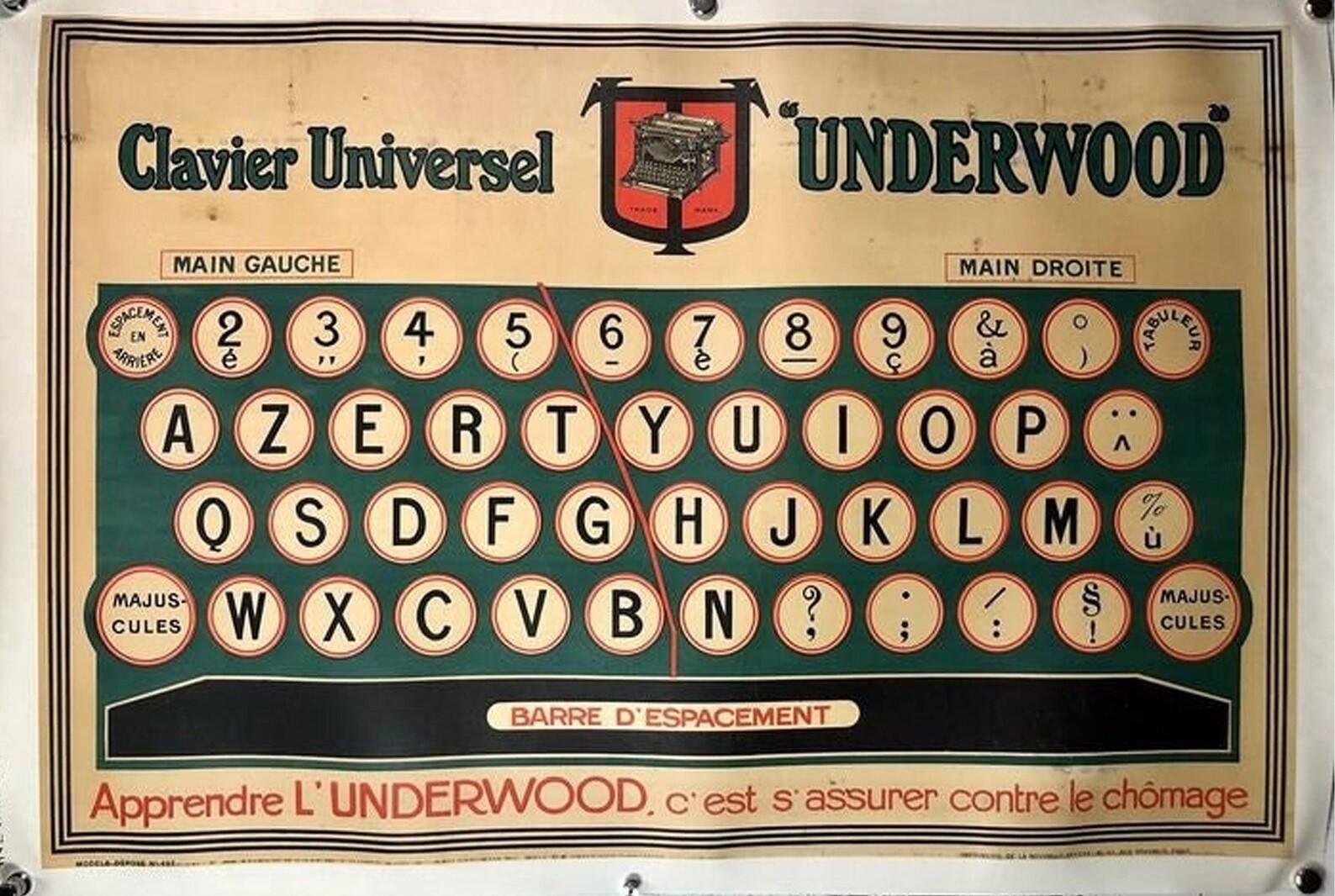
Anyone who thinks that only the azerty keyboard was used in France is now mistaken. The authors Pain and Mamet show three French keyboards in their Livre Illustré of 1908: one belonging to a shift machine, and one to a double shift machine, both with an azerty letter order and a full keyboard machine that has awerty. All three are called ‘clavier universel’, universal keyboard.
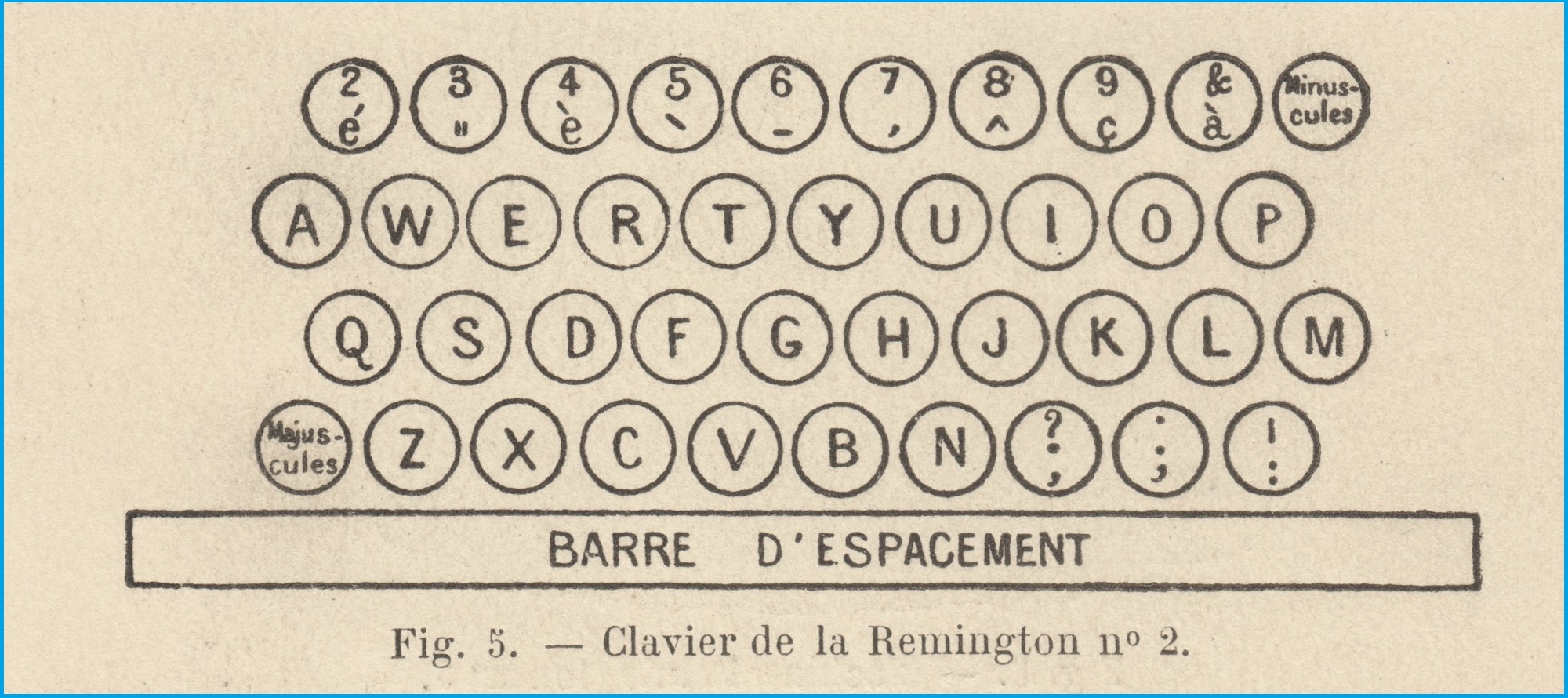 What is not widely known, or rather virtually unknown, is that the awerty keyboard is the oldest of the French standard keyboards. As early as 1890, Drouin depicted the awerty keyboard for a Remington in his book Les machines à écrire. There is not even remotely a mention of an azerty keyboard in it. The same image can be found in the Revue Internationale of April 1890.
It is not known when the awerty keyboard first appeared. “For more than twenty years, the keyboard, called ‘universel’, has been in use,” wrote Georges Sénéchal in 1907. 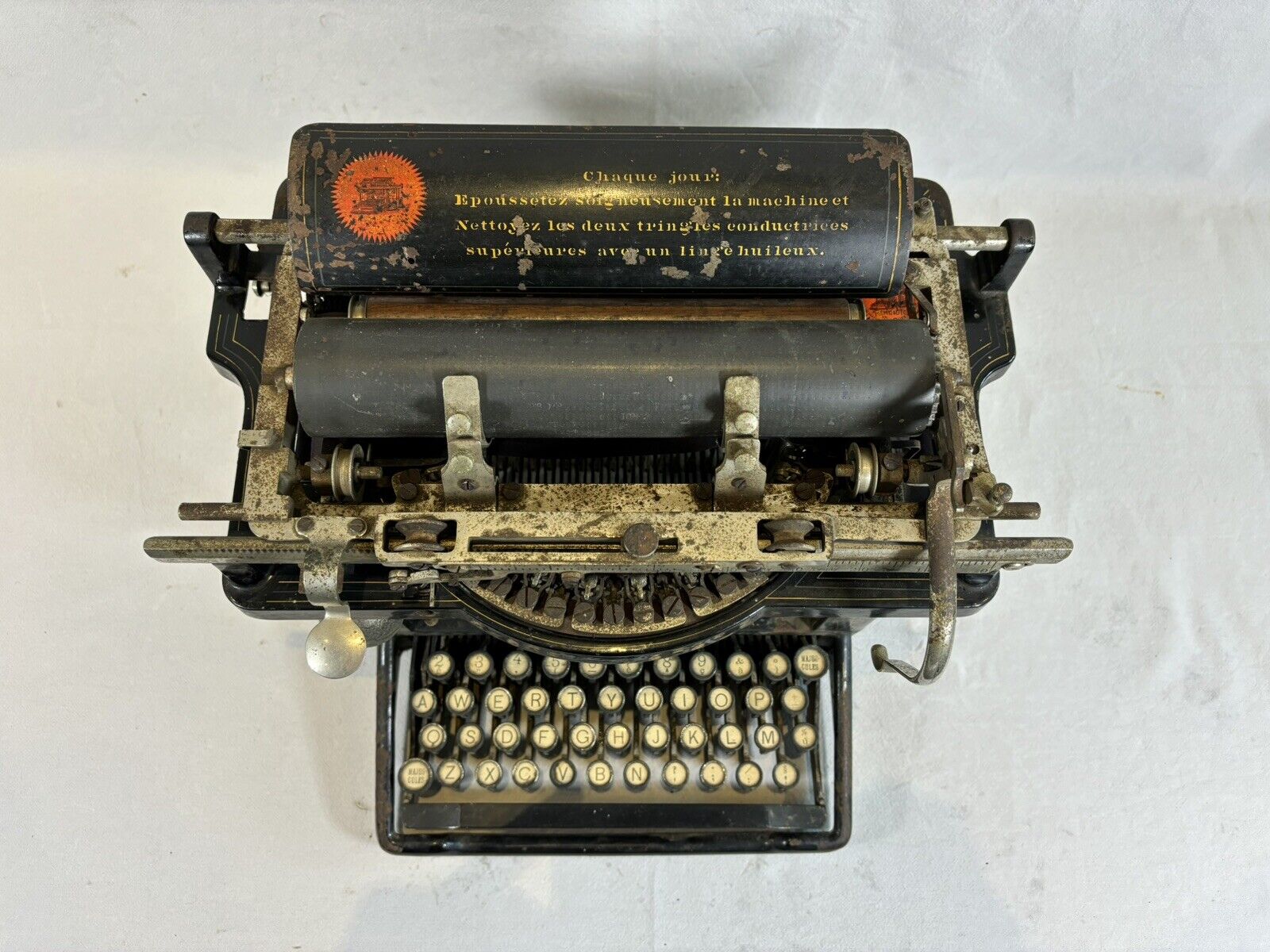 A Remington 5 with # 29592 has survived the test of time and might have been the oldest known.
 All English North’s machines from the 1890s, intended for the French market, were equipped with an awerty keyboard. There is also a Rem-Sho 3 known with such a keyboard.
Around 1900, the awerty order must still have been the standard. The Phonetic Journal of December 1901 wrote: “In the standard French key-board, the Q and the A are transposed, and the figures are placed in the upper-case on shift-key machines.”
awerty full keyboard
Full awerty full keyboards must have been uncommon, but they were there. However, so far, the Yost 10in our opening image is the only one known to exist. The letter sequence does not differ from that of an American Yost 10, except that the Q and A are swapped. Of course, the é, è, à, ç, ù and the Fr sign have been given a place. For this, the fractions and, among other things, the $ and £ signs had to make way.
Remarkably enough there a Yost 10 with an azerty keyboard alo exists, although it seems to have been converted afterwards. And as if it is not enough with the exceptions, there is an Adler 7 with awerty, a machine with double shift, cocking a snook at Pain & Mamet.
With the disappearance of the full keyboard and the abandonment of Navarre and his followers’ resistance to the ‘clavier universel’ around 1910, almost all keyboards in France were azerty. There is one exception, though: a resistant zhjay keyboard that had installed itself on a Typo, but that can be read elsewhere.
The ‘clavier Français’, the French keyboard, was created in 1907 as an alternative to the so-called universal keyboard. In April of that year, Albert Navarre started La Revue Dactylographique et Mecanique, a French magazine for the office world.  Already in the second issue, a transcript appeared of a lecture that Georges Sénéchal had given shortly before, based on findings by his companion Henri Dupont a year earlier, and published in La Plume Sténographique, in which a new keyboard was proposed: “un clavier idéal, bien approprié à la langue française”, an ideal keyboard, well suited to the French language. It would be the start of an intensive and optimistic campaign.
The very next month, a proposal for yet another keyboard arrived on the doormat. It was by a certain Benoit. Henri Levesque, director of the Saint-Nicolas Institute, also took up the subject, and Dupont also made his presence felt and came up with his own keyboard. Navarre loved it, free copy.
In the months that followed, comments and proposals tumbled over each other, but on Sunday 13th October 1907, the decision was made: a real committee chose ‘la clavier français definitif’, the final French keyboard.
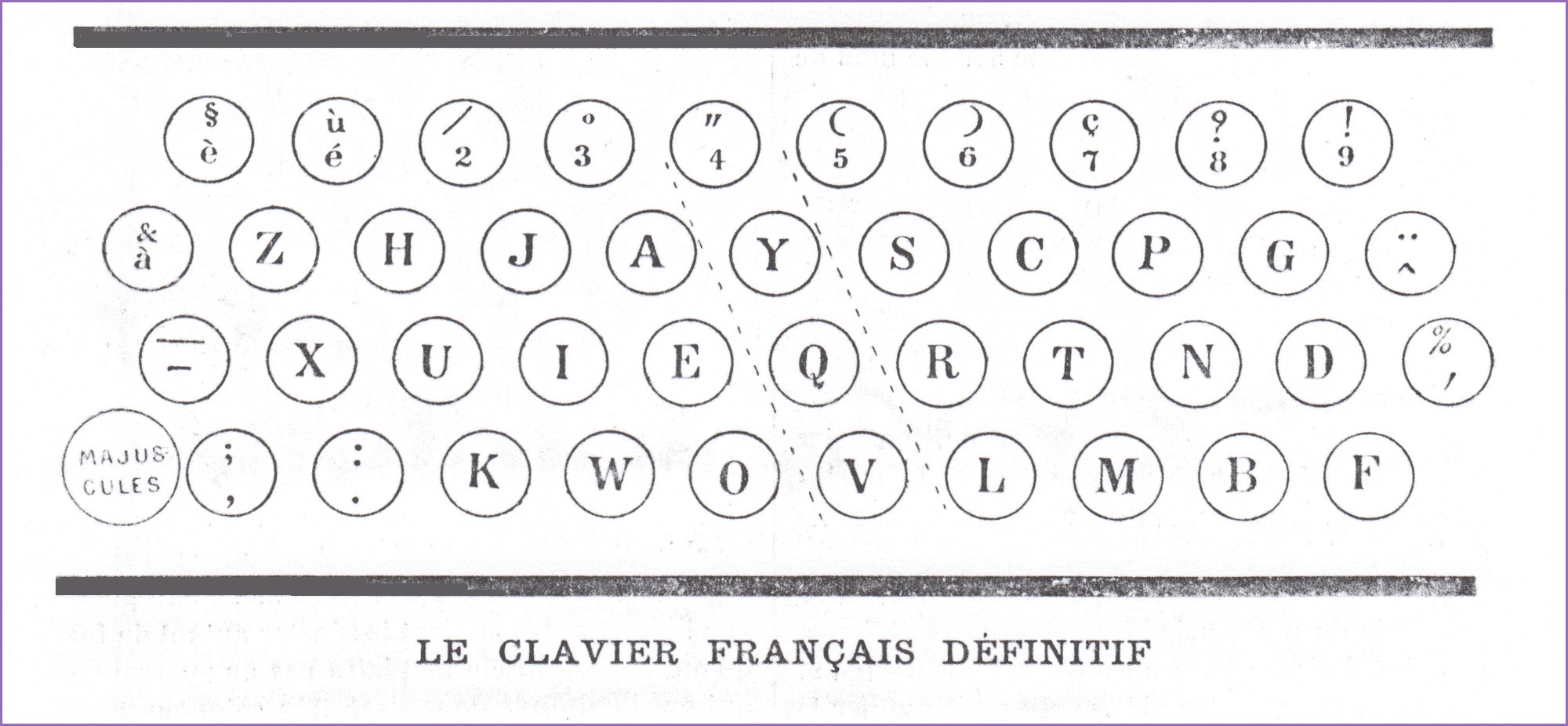
There were 500 responses, but none defending the American or universal keyboard. The considerations of the committee were mainly methodological in nature, which is not surprising: a large proportion of the twenty committee members was professionally involved in typewriting instruction. Navarre had no fewer than 5000 brochures printed with text and explanations, and in addition, a free leaflet with a reproduction of the new keyboard was available to subscribers of the magazine upon request.
In subsequent issues of the Revue Dactylographique, there was much support, from stenographers to resellers, and from several European countries. The members of the committee also did their best to promote the new keyboard; it received support from the various typewriter factories. Even Sidney Hébert, the manufacturer of the Lambert in France, wrote that he would have no problem switching to the French clavier. It was just lip service. There is no Hébert Lambert known with such a keyboard.
the practice was more intractable
Occasionally machines were converted, but the number has been small. There is a difference between the innovations in the professional world and the views of the average buyer, who is not aware of the latest developments. There are no known examples of converted machines.
 The only structural approach came from the Manufacture d’armes et cycles de Saint-Étienne, originally an arms manufacturer, founded in 1885. From March 1908, the company sold the Baka V, which was a German Stoewer model 2, which had been put on the German market in July 1905: “We have the privilege to inform you that the new machine we are launching, the Baka No.5 with visible writing, for the price of 480 francs, has introduced the clavier français”. If the Stoewer 2 was already a rarity, the Baka Visible 5 is that squared.
Stoewer was quite active in advertising in the RD, and the firm had a sales office in Paris at 149 Boulevard Ney. The Stoewer Model IV was sold there at the time. Baka’s were apparently leftover stock. There was a separate sales point for that too: 40 Rue du Louvre, right next to the large warehouse of the Manufacture d’armes et cycles de Saint-Étienne.
typo
In 1908, the Sun Standard is also said to have equipped a number of machines with the Clavier Français, but the announcement was somewhat vague and although an advertisement is known, actual machines with that keyboard never turned up.
A 1911 Annuaire also mentioned the Remington 7, the Ideal, the Remington-Sholes, and the Japy as machines that were supposedly equipped with the new keyboard, but I am not aware of any examples thereof.
 Sales of Bakas were also not a great success, however, around 1910, the Manufacture d’armes et cycles de Saint-Étienne sold the Typo, a pseudonym for the shortly before launched Imperial, an English machine and successor to the Moya. The Manufacture launched Moyas on the French market at the time.
The Manufacture had no less than 150 Typos in its own use, all equipped with the Clavier Français. The machines for sale were also equipped with that keyboard. With a small additional payment, another keyboard could also be ordered. The Typo is the only machine that was equipped with the Clavier Français as standard.
In France itself, the azerty keyboard became standard from 1910 onwards. A good example of the debacle of the zhjqy keyboard, the ‘clavier français’, is that Albert Navarre, its great advocate, started equipping his practice keyboards with the azerty sequence from 1910 onwards.
 The azerty keyboard is generally considered to be the French keyboard, a variant of the universal qwerty. It has been for quite some time, even in Mozambique, and most current computer keyboards in France are equipped with it, but nevertheless, it has only been common since about 1910. Before that, there was the awerty keyboard, as well as some other French experiments. In addition, there is the Dactyle with its own French Blickensderfer keyboard.
You can not call the ‘clavier universel’ much more than a small version of qwerty. Of course, there are the accents, and the ç, but the typical French characters like é and à are not there in uppercase, also the French ligatures ‘æ’ and ‘œ’ are absent.
However, we do not get any wiser about the origin of the specific azerty sequence in the literature, not even from a French ‘keyboard expert’, Delphine Gardey.
 In any case, it was not until early in the twentieth century that the azerty keyboard became generally accepted in France. Even Alfred Navarre, the advocate of a completely different French keyboard, switched to azerty from 1910 onwards, and equipped his practice keyboards with it.
Somewhat battered, this Yost 10. The rear part of the basket cover is gone. However, that is not the reason to be put in the spotlight here. It is a machine sold in France, although, that is not necessarily recommendable either.
This Yost 10 is the only known full keyboard machine with an awerty keyboard. Read carefully: it does not say ‘azerty keyboard’.